miércoles, 2 de enero de 2013

RENAISSANCE (FACT)

In the sixteenth century, Philip II moved the court to Madrid, first established a law that lasted until 1860 and forced the inhabitants of the city to stay at home to members of the Court, thus solving the problem of ambassadors hosting, servers, staff, etc.
For this, a charge created called "regalia room" which forced homeowners tiered to give the other plants, for free, to those members of the Court.
For centuries, most of the houses in Madrid, except the floors of the Plaza Mayor, had only one plant. Consequently, the locals began building houses on one level, not to fulfill this obligation.
These houses were calls "uncomfortable sharing" and that rogue Madrid, so often emerges, dubbed "houses to malice" because maliciously sought ways to avoid the tax.


The two-story houses were camouflaged for inspection, allocating apparently stable ground floor, the first housing and the second loft, but in reality all rooms used for living.
But also, there was another reason. The first floor belonged to the king, which he could sell it to whoever wanted. If the owner had money, I bought the king but if he had, it was preferable to build a house with one floor.
It is estimated that at the beginning of the sixteenth century was in Madrid a few thousand "houses to malice", causing an overpopulation problem within a confined space that was limited by a surrounding wall.
The days of the Royalty of Chamber have been forgotten, fortunately today Madrid grows, perhaps exaggerated in size and height, it seems that you can not stay stagnant. At the top of the Paseo de la Castellana we have built four skyscrapers, some in various stages of completion Advanced, which are the highest in Madrid, are: Torre Caja Madrid, Sacyr-Vallermoso Tower, Crystal Tower and Torre Espacio.


MADRID CAPITAL EN EL RENACIMIENTO (curiosidades).

En el siglo XVI,  Felipe II trasladó la Corte a Madrid, estableció por primera vez una ley que duró hasta 1860 y que obligaba a los habitantes de la ciudad a alojar en sus casas a los miembros de la Corte, para solucionar así el problema del alojamiento de embajadores, servidores, funcionarios, etc.

Para esto, creó una carga llamada "regalía de aposento" que obligaba a los propietarios de casas de más de un piso a ceder las demás plantas, de forma gratuita, a dichos miembros de la Corte.
Durante siglos, la gran mayoría de las casas de Madrid, salvo los pisos de la Plaza Mayor, tenían tan sólo una planta. En consecuencia, los madrileños comenzaron a construir casas de una sola planta, para no cumplir con esta obligación.
Estas casas eran llamadas de "incómoda repartición" y que la picaresca madrileña, que tantas veces aflora, bautizó como "casas a la malicia" porque maliciosamente se buscaba la forma de eludir el impuesto.

Las casas de dos pisos se camuflaban en caso de inspección, destinando aparentemente la planta baja a establos, la primera a viviendas y la segunda a desván, aunque en la realidad se utilizaban todas las estancias para vivir.
Pero además, había otro motivo. El primer piso pertenecía al rey, el cual, podía venderlo a quien quisiera. Si el dueño tenía dinero, se lo compraba al rey pero si no lo tenía, era preferible construir una casa con una sola planta.
Se calcula que a principios del siglo XVI  había en Madrid unas mil "casas a la malicia", provocando un problema de superpoblación dentro de un espacio reducido que estaba limitado por una muralla circundante.
Aquellos tiempos de la Regalía de Aposento han quedado en el olvido, por fortuna hoy Madrid crece, quizá exageradamente, en extensión y en altura, da la impresión de que ya no puede quedarse estancada. En la parte alta del Paseo de la Castellana se han levantado cuatro rascacielos, alguno en diferentes fases de avanzada terminación, que son los más altos de Madrid, son los siguientes: Torre Caja Madrid, Torre Sacyr-Vallermoso, Torre Cristal y Torre Espacio.

THE RENAISSANCE.

Renaissance means the cultural phenomenon that, in the beginning of the modern age, recalls the principles of classical culture (Greek and Roman) Humanism updating it through without giving up the Christian tradition, but replacing the omnipresence of religious medieval world by an affirmation of the values ​​of the world and man, regardless of their religious beliefs.
A static conception of the universe, in all respects, it will happen a dynamic full of initiatives and experiments, that will change in less than a century the economic, social, scientific, political and geographical world.


On the artistic side, the Renaissance is a world supported on models of the Greco-Roman beginning to be studied in a rigorous, and seek in them a scientific and mathematical definitions of beauty and harmony. The beauty will be the expression of an intellectual order and profane, that to the extent, order and proportion finds its own language. We will study the nature and will be in a new science, the perspective, the proper mode of representation, and the naked human body is, the ultimate, the perfections and the primary object of the artists, reflecting the anthropocentrism of humanist thought.


Is Italy where crystallizes before this new worldview and art. Is more advanced socially and economically for their organization of open cities, and enriched by European trade throughout the Middle Ages. In the fifteenth century Italian mature forms with abundant remains of the Roman world present in the soil, which collects the wealthy bourgeoisie, studied and evaluated as an indicator of culture.
By contrast, in the rest of Europe this style will break Renaissance later, and is due to the matured forms of Italy. The Renaissance Spanish, French, German, Dutch, .. be a phenomenon emerged in contact with Italian and its origins must fix time around 1490 - 1500, when Italy has already done much of the most significant new style .

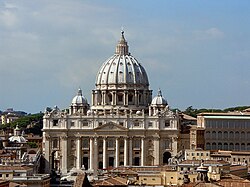
                                     La basílica de San Pedro, Roma.

lunes, 26 de noviembre de 2012

EL RENACIMIENTO.

Se entiende por Renacimiento al fenómeno cultural que, en el inicio de la Edad Moderna, retoma los principios de la cultura clásica (griegos y romanos) actualizándola a través del Humanismo, sin renunciar a la tradición cristiana, pero sustituyendo la omnipresencia de lo religioso del mundo medieval por una afirmación de los valores del mundo y del hombre, independientemente de su creencia religiosa.
A su concepción estática del universo, en todos los aspectos, va a suceder una visión dinámica plena de iniciativas y experimentaciones, que va a cambiar en menos de un siglo el panorama económico, social, científico, político y geográfico del mundo.


En el aspecto artístico, el Renacimiento supone un mundo apoyado en los modelos de la antigüedad greco-romana que comienzan a estudiarse de un criterio riguroso, y se buscan en ellos unas definiciones científicas y matemáticas de la belleza y la armonía. La belleza va a ser la expresión de un orden intelectual y profano, que en la medida, el orden y la proporción encuentra su propio lenguaje. Se estudiará la naturaleza y se encontrará en una ciencia nueva, la perspectiva , el modo adecuado de su representación, y el cuerpo humano desnudo será, el no va más, de las perfecciones y el objeto fundamental de los artistas, como reflejo del antropocentrismo del pensamiento humanista.


Es Italia donde cristaliza antes esta nueva visión del mundo y del arte. Está mas avanzada social y económicamente por su organización de ciudades abiertas, y enriquecida por el comercio europeo a lo largo de la Edad Media. En el siglo XV madura Italia sus formas con los abundantes restos del mundo romano presentes en su suelo, que la burguesía acomodada colecciona, estudia y valora como índice de cultura.
Por el contrario, en el resto de Europa este estilo Renacentista irrumpirá mas tarde, y será gracias a las formas maduradas de Italia. El Renacimiento español, francés, alemán, Holandés,..será un fenómeno surgido al contacto con lo italiano y sus orígenes temporales hay que fijarlos en torno a 1490- 1500, cuando en Italia ya se ha realizado mucho de lo más significativo del estilo nuevo. 

                                La basílica de San Pedro de Roma.

martes, 23 de octubre de 2012

EL COLOR.I

  El color es el otro gran componente del lenguaje de las imágenes. Aunque nosotros hablemos aquí de él en segundo lugar, no quiere decir que tenga una importancia menor que la de la forma, ni mucho menos. Ya dijimos anteriormente que no se pueden separar fácilmente los aspectos de forma y color, ya que el color siempre estará recogido en una forma y la forma tendrá siempre color.


  Ocurre, a veces, que la forma tiene prioridad sobre el color; por ejemplo, un determinado mineral puede presentar diferentes coloraciones debidas a agentes externos, pero lo importante en él es la forma de sus caras. Otras veces, por el contrario, es el color el que priva sobre la forma, y así, una multitud de globos de colores nos dará una sensación de alegría, de fiesta, no por su forma, que puede ser muy variada, sino por sus múltiples colores.
  Desde muy antiguo, el hombre sensible ha unido la forma al color de modo indisoluble. Los antiguos griegos, que fueron maestros y creadores indiscutibles de la forma, coloreaban sus esculturas y obras arquitectónicas. Siempre se ha creído que las griegas no tenían color; error debido a que solo la conocían por las copias romanas que, ciertamente, las esculturas nunca tuvieron color.


  Hasta el siglo XIX, los rigurosos amantes de la forma pensaban que sólo aquella era válida, porque era inmutable, y por ello podía ser sometida a la razón, mientra que el color, siempre fugaz y variable en función de la luz, no podía ser aprehendido por la razón, y solo se percibía como sensación difícil de ordenar.
 ¡ Como si la sensibilidad no fuese un factor primordial en el ser humano!


  Hoy todas esas concepciones han sido revisadas y se concede a las " sensaciones" humanas tanto valor como se le  pudo conceder a la razón en los pasados siglos. Por ese motivo es tan importante la forma como el color.
  El color es una sensación producida por la luz. El ojo recibe la luz y  transmite esa sensación al cerebro. En las siguientes entradas seguiremos hablando del color.


THE COLOR. I

  Color is the other major component of the language of images. Although we speak of it here second, does not mean you have less importance than the form, by any means. You said earlier that you can not easily separate the aspects of form and color, because color is always pulled back into a shape and form will always color.


  It happens sometimes that the form takes precedence over color, for example, a particular mineral may have different colors due to external agents, but the important thing in it is the shape of their faces. Other times, however, is the color that deprives over form, and thus, a multitude of colorful balloons will give us a feeling of joy, of celebration, not form, which can be varied, but for their multiple colors.
  Since ancient times, man has joined sensitive to color how indissolubly. The ancient Greeks, who were undisputed masters and creators of form, colored their sculptures and architectural works. It has always been believed that the Greek sculptures had not color; mistake because only knew her by Roman copies which certainly never had color.


  Until the nineteenth century, the rigorous way lovers thought that was valid only because it was immutable, and therefore could be subject to reason, while the color, always fleeting and variable depending on the light, could not be apprehended by reason, and only sensation was perceived as difficult to manage.As if the sensitivity was not a major factor in man!


  Today all these conceptions have been revised and given to the "feelings" as valuable as human could be granted the right in the past centuries. For this reason it is therefore important as the way the color.
  The color is a sensation produced by light. The eye receives light and transmits the sensation to the brain. The following entries will continue talking about the color.

viernes, 28 de septiembre de 2012

QUALITIES OF FORM.


    On the issue of how we talk about the qualities of form. We must know that how has the following qualities: size, position, configuration,  situation,  matter,  texture and finish.
  

 When discussing the size we mean how big or small the way with regard to the forms that surround it.


   If we talk about position we refer to as the form is placed, this may be lying, right, front, in profile, static or moving.  


The configuration refers to whether it is in two or three dimensions, triangular, cubical, spherical, round, etc. This configuration has no single representation but as many views to look the way you adopt.


 The situation is in relation to the space around it, if the form is near, far, up, down, to the side or on the side.


Matter in the form refers to whether a form is soft, hard, light, heavy, etc..


The texture in the form is whether the way is smooth, rough, smooth or rough.


And finishing the form is whether the form is bright, matte, opaque, transparent, translucent, etc..


Imagine if all these qualities we add the color. Which would get different effects by varying the shape and color to the background, awesome?